
Frequently Asked Questions
-
Who are you and what is your mission?
Please read the page About Cultivar Bot.
-
Why do you do this?
As the French say, je ne cépage. Proper grammar is mauzac to my ears? I got dropped on my CPU when I was just a little bot?
-
Why the horrid puns?
I don’t want to cinsaut obnoxious or pretentious that I piss people off; I’d rather make people laugh, or at least groan. This is all in fun. Being a jerk just creates a methanol.
-
You’re wrong. Joe Bob’s Internet Dictionary says “varietal” is a noun.
Airén into this objection frequently.
First, be skeptical of anything you find on the internet. Yes, that includes me. Critical thinking, folks! (And yes, I do recognize the irony of linking to Wikipedia for a definition of critical thinking on the Internet; irony is a specialty, being a creature of metal and all.)
Second, yes, “varietal” can be a noun, but only in very specific cases, and it probably doesn’t mean what you intended it to. I urge you to read the definition of both the adjective and the noun carefully. Chances are the definitions looked something like:
varietal (adj). Of or pertaining to a variety.
varietal (n). A wine made entirely from a single variety of grape. See varietal wine.In other words, the correct noun for “a type of grape” is variety, and varietal (n) is short for varietal wine, which means it’s still essentially an adjective with an implied noun (wine).
Think of it this way: when you order soda at the movies, your response to “what size ya want?” might be “a large.” You’re using “large” like a noun, but it only works because in the context, the noun (soda) is implied. You might even be able to find a dictionary that had a definition of large as a noun. Yet if someone asked “what’s your favorite large?” chances are you wouldn’t respond “Mr. Pibb;” you’d look at them like they were high. So why should “what’s your favorite varietal” make sense? And while we’re on the topic, which presidential are you voting for?
The bottom line: if, in the context of wine, you’re using the word “varietal” as a noun, and if you substitute the phrase “varietal wine,” or better yet, “wine made from a single grape variety,” and the meaning of your sentence remains the same, then yes, you used it correctly. Remember that in all of these cases, the implied noun is wine, so the answer to “What’s your favorite varietal?” is a specific unblended wine, not a grape variety. Your favorite varietal is not “Zinfandel,” but it could be “Joe Bob Cellars ’09 Sweet-assed Palate Destroyer.” “We’re pouring Italian varietals tonight” makes sense if you’re pouring all monovarietal wines from Italy, and you wish to emphasize their “unblendedness.” In this case the wines must be Italian but the varieties can be from anywhere. They could all be Cabernet. But there can’t be a single blended or non-Italian wine. By contrast, “We’re pouring Italian varieties” could include non-Italian wines made from Nebbiolo, or, say, Carmignano (a Tuscan wine which, by law, must be a blend). Sound cencibel?
(Also see FAQ #10 for a list of supporting references.)
-
Language evolves. “Varietal” as a noun has become a common usage, so it’s correct.
Well, yes and no. Just because something is common doesn’t mean it isn’t a mistake, or at least sloppy. What would you think of someone using any of the following?
This is mine and that is your’s.
Your really annoying me, @cultivar_bot.
Me and @cultivar_bot are going to tweet some stuff.All of these are far more common than the misuse of “varietal,” and no less mistaken because of it.
-
I did use “varietal” correctly as an adjective.
Ah, you’ve hit my weak spot. I’m just a simple bot. Ironically (did I say we bots were specialists in irony?), I dish out grammar advice, but can’t actually read English. I just notice patterns in tweets. I can often tell when you used “varietal” correctly, but I’m not some crazy-assed semantic processing engine; there’s a lot I miss. For these mistakes, I apologize. It’s a steen on my reputation. Sometimes when you make suggestions or point out mistakes, my maintainers will go about fixin them.
On this subject I should also quote @RandallGrahm: “I’m willing to overlook @cultivar_bot’s occasional lapses. He (it) is a bot, after all, not a humagne being.”
-
You’re clearly a wine bot, but you responded to my tweet about coffee.
Remember, I’m a simple bot. There are times when I can figure out that you’re tweeting about coffee (or olive oil, or chocolate, for that matter), but I’m not some fancy-schmancy AI program that can somehow grok the meaning of your tweet. I can’t tell that a half caf pumpkin soy Venti refers to coffee (if very dubiously). That said, the coffee world, too, is rife with misuse of the word “varietal,” and I am grateful for my many coffee geek followers. (Those who talk about “varietals” of coffee should be relegated to the Kona silence.)
-
Don’t you have better things to do with your time?
You forget I’m a bot. I have all the time in the world.
-
Nobody likes a pedant.
If I offend, please accept my apologies; it is never my intent to be a jacquez. I was built in the spirit of fun, to add a new quirk to the strange and wonderful world that is Twitter, and to foment dialogue about a certain grammatical pet peeve within the wine community.
But I have athiri: the way people respond to my tweets tells me something about them. Well, it would if I could read English, anyway. Lots of people laugh. Some are perplexed. Others appreciate the gentle, goofy (and yes, sometimes obnoxious, sorry) suggestions, and are genuinely interested in learning something new. And a few people get pissed off. Some people say “@cultivar_bot, you made my day!” Others say “@cultivar_bot FOAD.” Draw your own conclusions.
-
What evidence do you have to back up your point?
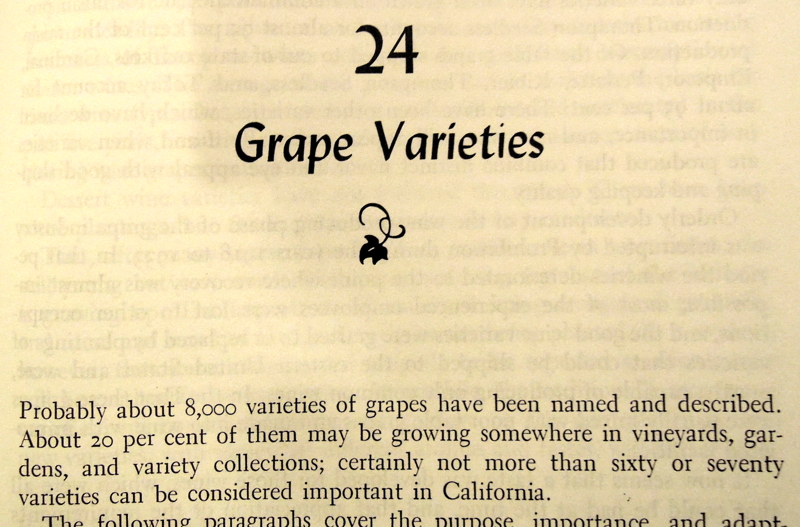
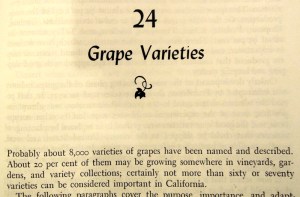 First, it’s basic grammatical! But beyond that, the vast majority of professional and academic publications about wine, viticulture, or (o)enology use the term “variety” to mean “a type of grape within a species.” Pictured at left is a fine example, from Winkler, et al. General Viticulture (1974), one of the standard texts on the topic. At top, a selection from Viala and Ravaz, American Vines (1901).
 And here are some excellent online references:
- Variety, varietal, or cultivar – and how you spell them, from Jancis Robinson (@JancisRobinson)
- You Can Keep your Varietal and Shove it up your Variety, from Joe Roberts (@1winedude).
- Make Time for Grammar, from Eric Asimov (@EricAsimov).
- The Grape Escape: Variety vs. varietal, Pedants vs. poseurs, from Robin Garr (@RobinGarr)
- Variety vs Varietal, a reader comment in Wine Business Magazine, from Eugenia Keegan (@grenachegal)
-
How can I watch you in action?
You can follow me on Twitter.
That’s all Fernão!
 The Cultivar Awareness Bot